


In the scorching summer sun, when taking your child to the beach or for outdoor activities, a good pair of children’s sunglasses is not only a fashion item but also an “invisible armor” protecting their eyes. As a parent, how should you choose sunglasses for your child? Please keep these three key points in mind.
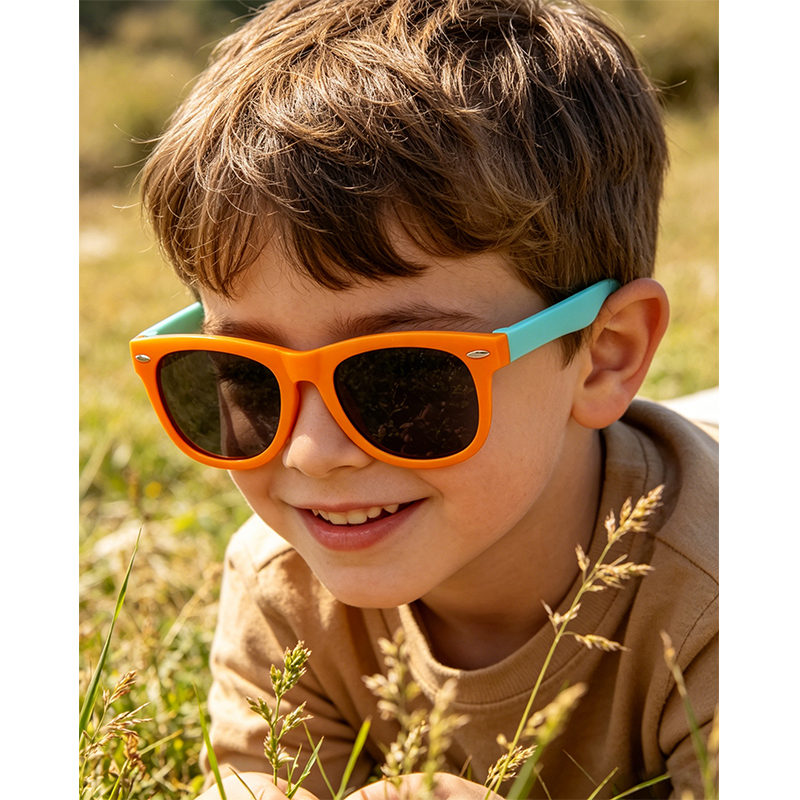
I. When buying sunglasses for your child, pay close attention to these four things:
Look for the “UV400″ label: Children’s lenses are more transparent than adults’, making it easier for ultraviolet rays to penetrate and reach the retina. Always choose products labeled “UV400″ or “100% UV protection” to ensure they block both UVA and UVB rays.
The lens material must be impact-resistant: Children are active, and broken lenses can be very dangerous. Polycarbonate (PC) is currently the safest lens material, with 10 times the impact resistance of ordinary resin, and it does not produce sharp fragments.
The frame should be rounded and without sharp corners: Check that the edges of the frame, nose pads, and hinges are smooth and rounded. Choose one-piece silicone nose pads or adjustable soft nose pads to avoid pressure on the bridge of the nose. The temples should be soft and flexible, ideally with a non-slip design.
Size should fit snugly and not slip: Have your child try them on; the frames should not be too tight or too loose. Wrap-around designs or adjustable headbands ensure the glasses stay securely in place when the child is running or jumping.
A small reminder: Don’t buy “toy sunglasses” from roadside vendors. They may not offer UV protection and, due to their dark tint, may dilate the pupils, allowing more harmful light to enter the eyes.
II. Do children need polarized sunglasses?
Absolutely. Children often play in highly reflective environments such as beaches, water surfaces, snowfields, and playgrounds. Ordinary sunglasses only darken the overall light, but the glare from water, sand, and roads remains. Polarized lenses can filter this reflected light in a targeted manner, allowing children to see more clearly and comfortably, reducing squinting and eye strain.
Especially when children are cycling, skiing, playing in the sea, or driving with the windows open, polarized sunglasses significantly improve visual quality and safety. Therefore, choosing polarized sunglasses for children is a more professional choice.
III. What Sunglasses Material is Best for Children?
Currently, the two materials most widely recognized as best for children are:
TR90 (Plastic Titanium): Ultra-lightweight (30% lighter than ordinary acetate), highly flexible, impact-resistant, and not easily deformed. Suitable for active school-aged children; it won’t break even when bent.
Food-Grade Silicone: Designed specifically for young children, it’s soft, non-toxic, odorless, and highly elastic. The one-piece molded silicone frame fits the child’s face well, without causing pressure or allergies.
Recommended Combination: Use TR90 or silicone frames and PC polarized lenses for a balance of safety, comfort, and visual quality.
We—Your Trusted Partner for Customized Children’s Eyewear
As a professional foreign trade eyewear company, we not only provide high-quality children’s sunglasses to individual buyers but also offer spot sourcing and in-depth customization services to global brands:
Extensive Selection: From silicone for infants to TR90 polarized for teenagers, covering all age groups from 0-12 years old.
Flexible order quantity: We support small-batch in-stock purchases for quick trial orders, and also accept large-volume OEM/ODM customization.
Brand empowerment: Laser/silk screen printing of logos on the temples, matching customized eyeglass cases, eyeglass bags, and microfiber cleaning cloths help you build your own brand.
Protect your child’s eyes, starting with a pair of professional children’s sunglasses. Contact us for product selection advice or customization solutions!
Post time: Apr-21-2026