


The birth of optical eyeglasses marked a leap forward in human understanding of optics. Records show that in 1275, Italian physicists Alessandro Spina and Alfa Giovanni collaborated to develop the first handheld crystal lens eyeglasses. After more than a decade of improvements, by 1300, they could be fixed in place by adding temples, marking the formal evolution of eyeglasses from a “handheld magnifying tool” into a wearable visual instrument. During the Ming Dynasty, eyeglasses were introduced to China via the Silk Road, initiating the history of optical correction in East Asia.
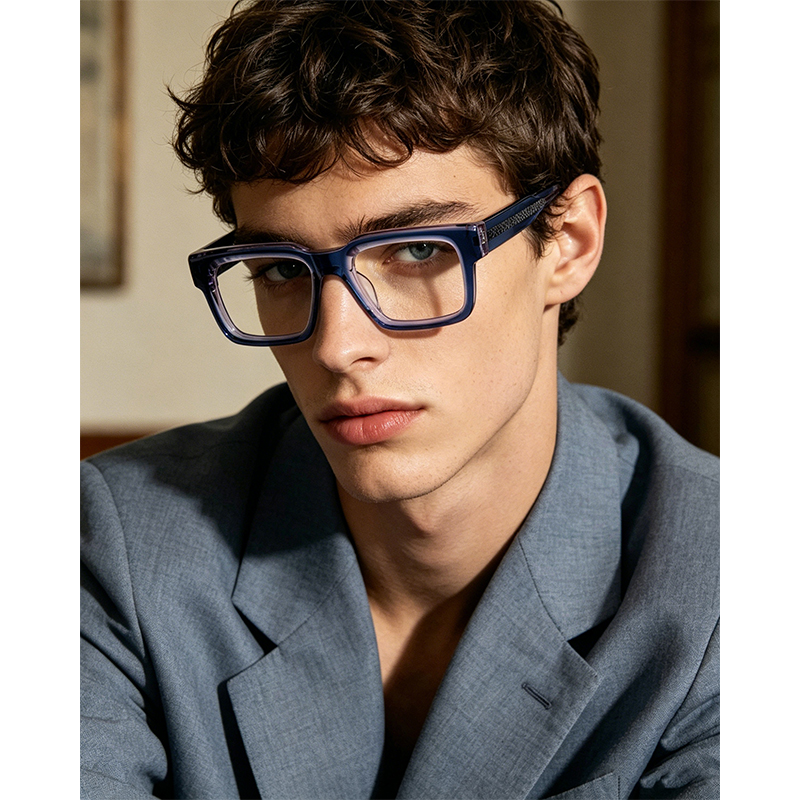
In terms of materials, eyeglasses have evolved from heavy glass to resin. Early lenses were made of natural crystal or ground glass, offering excellent optical performance but being fragile and extremely heavy. With advancements in materials science, modern optical eyeglasses have transitioned to resin lenses, resulting in a significant reduction in weight and a marked improvement in impact resistance. Meanwhile, optical lenses have evolved from the initial single-vision lenses to bifocal lenses and the more advanced progressive multifocal lenses. The latter, designed by Frenchman Metternich in 1951, achieves a seamless transition in refractive power from distance to near vision through continuous changes in lens curvature, providing a natural visual experience for presbyopic individuals without a dividing line.
Recent Trends in Optical Eyewear Materials and Elements
Looking ahead to 2026, optical eyewear design exhibits a diverse and fusion-like characteristic. In terms of materials, acetate panels remain an unshakeable core. According to authoritative trend predictions, in 2026, acetate panels will present rich visual effects such as retro tortoiseshell patterns, marble textures, and layered gradients. Color options range from neutral and calming to vibrant and dynamic transitions. Metallic materials are making a comeback with a new look of two-tone electroplating (such as black on the outside and gold on the inside), giving classic styles a modern deconstructed feel.
In terms of design elements, five major themes are dominating the market: “Sculptural” emphasizing three-dimensional contours and heavy carving; “Emotional” incorporating nostalgic and handcrafted details; “Everyday Punk” drawing on the rebellious energy of youth subcultures; “Surrealism” exploring imagination with unconventional shapes; and “Ultra-Lightweight” pursuing ultimate thinness and comfort. Ultra-lightweight designs often utilize high-density acetate, titanium, or 3D-printed flexible materials to achieve a near-unfelt wearing experience. Furthermore, the Y2K trend continues its resurgence, with transparent jelly-colored frames, rimless structures, and streamlined silhouettes becoming highly anticipated items in 2026, cleverly balancing millennial minimalist aesthetics with the sophistication of modern craftsmanship.
Why does acetate stand out among numerous eyewear materials?
The core appeal of acetate as the preferred material for mid-to-high-end fashion frames lies in its irreplaceable aesthetic expressiveness. Acetate fiber, derived from natural wood pulp or cotton linter, can achieve an infinite range of colors and textures through a complex lamination and dyeing process, from classic tortoiseshell and amber to highly transparent jelly colors and marble patterns. This richness and artistry are unmatched by metal or ordinary injection-molded materials. Secondly, high-quality acetate, after fine polishing, has a warm, jade-like feel, is skin-friendly and hypoallergenic, and is dimensionally stable and resistant to deformation. Finally, the acetate processing utilizes CNC programming cutting technology, eliminating the need for expensive molds and offering the flexibility of single-pair orders, greatly reducing the customization threshold and inventory pressure for brands, making “small batch, personalized” a reality.
As a foreign trade company deeply rooted in the custom eyewear industry, we are your best partner for grasping trends and establishing a foothold in the acetate eyewear market. We offer a vast selection of in-stock styles, keeping abreast of 2026 trends such as sculptural designs, vintage tortoiseshell, and Y2K transparent materials. We support small-batch in-stock purchasing to help you quickly test different styles. We also provide a one-stop ODM/OEM service, from custom logo design (laser engraving, silkscreen printing, metal labels) to complete brand packaging (glasses cases, bags, cleaning cloths), ensuring your brand story resonates from the moment you open the box.
Contact us to transform the charm of classic acetate into your unique market advantage!
Post time: May-19-2026