


In the 2026 eyewear market, optical eyewear has long transcended its function as a simple vision correction tool, becoming a composite medium integrating optical technology, ergonomics, and fashionable aesthetics. Whether you are a consumer seeking a top-tier visual experience or a brand with a global market presence, understanding scientific choices, material properties, and current trends is fundamental to making informed decisions.
I. The Art of Choosing Optical Eyewear: Precise Decision-Making in Three Dimensions
Choosing optical eyewear is not just about the frame’s appearance; it should be considered systematically from the following three dimensions:
1. Professional Optometry, Data First
Optometry is the cornerstone of eyewear prescription. A qualified optometry should include four core parameters: spherical power, cylindrical power, axis, and binocular pupillary distance. For progressive lenses, precise measurement of pupillary height is also necessary. It is recommended to choose a professional institution that provides in-depth visual function assessments, covering eight advanced indicators such as accommodation, convergence, and stereopsis. For progressive multifocal lenses, leading brands in the industry have implemented a 26-step optometry examination and a 68-step custom manufacturing process to ensure a perfect lens fit and comfortable wear without dizziness.
2. Scientific Matching of Refractive Index to Power Prescription
The refractive index determines lens thickness, but higher is not always better. A higher refractive index results in a lower Abbe number (a measure of dispersion), which may lead to rainbow-like patterns at the visual periphery. The industry consensus matching standards are as follows:
Below 300 degrees: 1.56 or 1.60 is sufficient, with an Abbe number of approximately 40-58, close to the natural value of the human eye.
300-600 degrees: 1.60 is the optimal balance point, 15% thinner than 1.56 while maintaining high clarity.
600-800 degrees: Consider 1.67.
Above 800 degrees: Choose a higher refractive index lens like 1.74.
3. Functional Lenses: Choose According to Your Needs
Blue Light Protection: Ideal for those who use screens for more than 6 hours a day. Choose a lens with an extremely light base color to avoid color distortion.
Graduated/Multifocal Lens: Suitable for users who need to see both near and far objects simultaneously, achieving “one lens for all scenarios.”
Polarized/Photochromic Lenses: Ideal for outdoor activities and driving.
II. Characteristics and Selection of Optical Frames Made of Different Materials
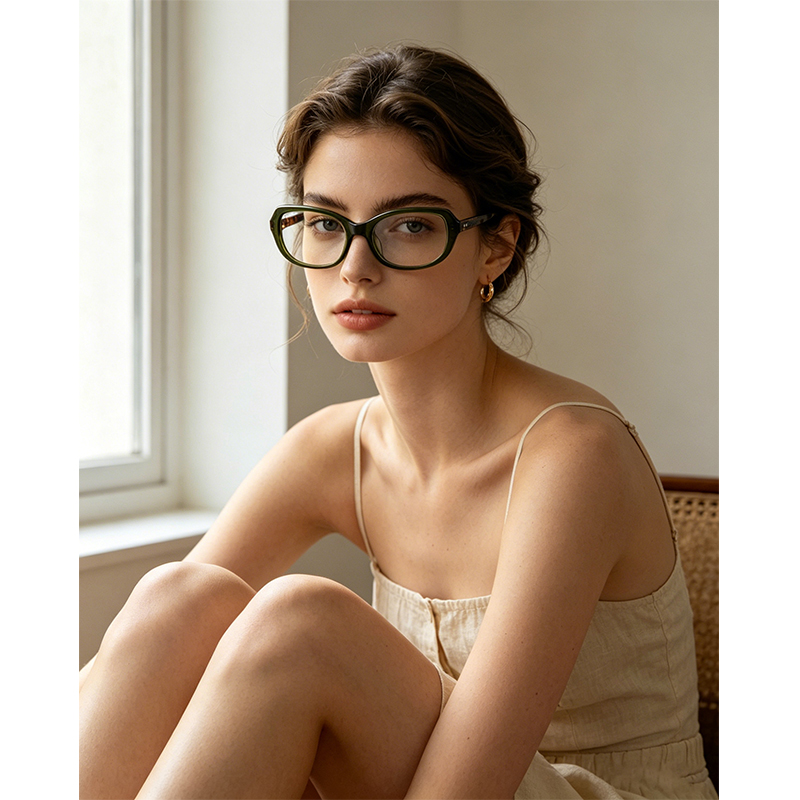
Acetate (Acetate): Rich in color and texture, with a warm feel and excellent fashion appeal. Suitable for retro-style designs and users who value aesthetics and a vintage look.
TR90 (Plastic Titanium): Extremely lightweight, flexible, and impact-resistant. Approximately 30% lighter than acetate, pressure-free wear, and a top choice for child safety. Suitable for sports enthusiasts, children, and all-day wearers.
Pure Titanium/β-Titanium: Ultra-lightweight, corrosion-resistant, and skin-friendly. Each frame weighs only 8-12 grams. Ideal for business professionals and hypoallergenic. Suitable for business professionals, those with sensitive skin, and those who prioritize quality.
Carbon Fiber: Extremely lightweight, high-strength frame. Weighing 6-10 grams per frame, these glasses are extremely impact-resistant, making them suitable for sports enthusiasts and those seeking a high-tech look.
Selection Guide: For stylish looks, choose acetate; for all-day comfort, choose TR90 or titanium; for sports, choose carbon fiber; for business professionals, titanium is the top choice.
III. Optical Eyewear Trends in 2026
In 2026, optical eyewear design will showcase a diverse fusion of technology, environmental friendliness, and retro aesthetics:
1. Smart Glasses Become Fully Practical
AI glasses have moved from concept to market, supporting functions such as voice interaction, autofocus, and motion data tracking. Brands like Google and Thunderbird are releasing new products frequently, accelerating the maturity of the industry chain. It is estimated that smart glasses shipments in China will reach 4.508 million units in 2026.
2. Environmentally Friendly Materials Become Mainstream
Sustainable materials have moved from marketing concepts to auditable standards. Bio-based acetate (70% bio-based content + 27% recycled materials) is favored by high-end brands. The application of recycled TR90 and environmentally friendly sheets is also becoming increasingly widespread.
3. New Trends in Frame Shapes and Colors
Polygonal/Wellington Frames: Rounded corners and inverted trapezoidal design, suitable for progressive lenses, minimizing blind spots.
Retro Resurgence: Boston round frames, small oval frames, and thin metal frames are making a comeback.
Low-Saturation Natural Colors: Milky white, sand, light blue, and mint green are becoming mainstream.
Geometric Reconstruction: Asymmetrical designs, half-frames, and cybernetic metal lines.
4. Functional Integration: Four-in-one coatings for blue light protection, UV protection, anti-fog, and easy cleaning are becoming standard. The demand for specialized lenses for different scenarios such as office work, driving, and outdoor activities is increasing, and the logic of eyewear selection is shifting from “one pair for all” to “scenario-priority.”
As a professional custom eyewear trading company, our product line covers optical frames made of all materials, including acetate, TR90, and titanium, keeping up with the 2026 trends such as polygonal frames and retro round frames. We support small-batch in-stock purchasing for rapid market testing and also undertake large-scale OEM/ODM customization to create exclusive brand series. From intricate logo customization on the temples (laser printing/silk screen printing/metal label) to complete brand packaging (eyeglass case/bag/cleaning cloth), our one-stop service helps you seize market opportunities.
Contact us to get the latest style catalog and customization solutions!
Post time: May-29-2026