


In the world of eyewear, while optical glasses and sunglasses belong to the same family of frames, they serve vastly different design purposes. Understanding these distinctions is fundamental for brands to accurately position their product lines and meet diverse consumer needs.
I. Core Design Differences: Function-Driven Distinctions
The fundamental difference in design logic between optical glasses and sunglasses stems from the essential differences in their usage scenarios.
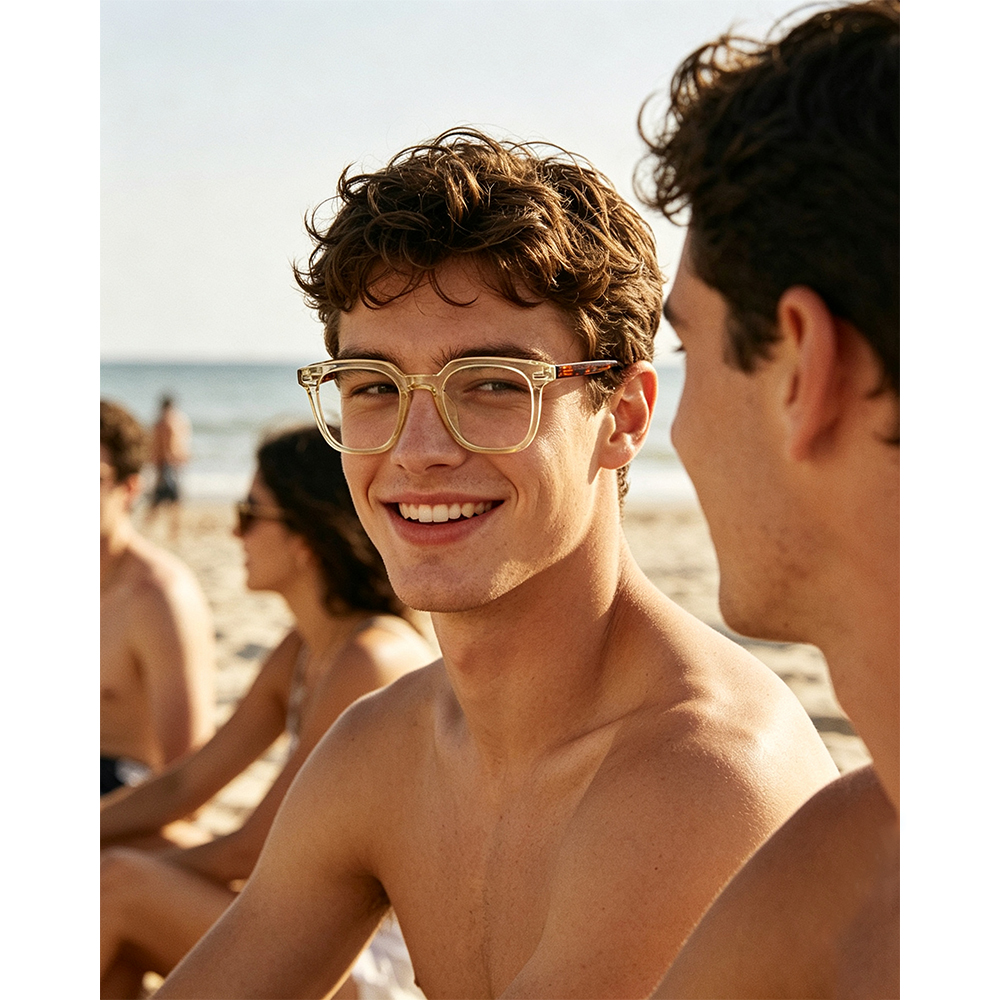
The primary mission of optical glasses is all-day visual correction and comfortable wear. Their design centers on prolonged use: frames emphasize lightweight construction and ergonomics; adjustable nose pads and temples that fit snugly without pinching the face are essential to ensure comfort during hours of continuous wear. Frame dimensions must precisely match the wearer’s pupillary distance (PD) to align the lens’s optical center with the pupil, thereby guaranteeing effective vision correction. Design styles tend to be understated, versatile, and professional, making them suitable for daily settings such as the office, school, or business environments.
In contrast, the core mission of sunglasses is light management and visual protection. Their design focuses on outdoor environments with intense light: lenses require UV400 protection and polarization capabilities, while frame designs prioritize coverage and light-blocking—often utilizing wraparound or oversized styles. Stylistically, they are bolder, more expressive, and fashion-forward, serving as accessories that showcase personality and evoke a vacation vibe.
II. What Do Optical Glasses Prioritize? Precision, Comfort, and Durability
Compared to sunglasses, optical glasses are held to higher standards in the following three areas:
Optical Precision: Optical glasses are corrective tools; lens prescription, astigmatism axis, pupillary distance, and pupillary height must be precisely matched. Any deviation can lead to visual fatigue or even dizziness—issues not typically associated with sunglasses, which function as non-prescription accessories.
Long-Term Wear Comfort: Optical glasses are often worn for eight hours or more; therefore, frame weight, the fit of the nose pads, and the flexibility of the temples are critical considerations. Lightweight materials such as TR90 and titanium are particularly important for optical frames.
Structural Durability: Optical glasses must withstand frequent putting on and taking off throughout the day; consequently, hinge durability and frame stability are subject to stricter requirements than those for sunglasses. III. Are optical frames made of propionate material a good choice?
Cellulose propionate (CP) offers a unique set of advantages as a material for optical frames.
In terms of performance, CP combines appropriate elasticity and toughness with excellent plasticity and flow characteristics, enabling a wide range of colors through diverse processing and coloring techniques. Its greatest strength lies in its stability and durability; it resists oxidation, decomposition, and aging when exposed to the atmosphere and is not easily flammable. Compared to traditional cellulose acetate, CP is less dense and lighter in weight, while offering outstanding luster and colorability.
Regarding the wearing experience, polished CP feels warm and smooth against the skin, making it comfortable for prolonged wear. Its balanced density gives the frames a substantial feel without placing an excessive burden on the bridge of the nose.
From a manufacturing perspective, the excellent flow properties of CP make it ideal for precision injection molding, allowing for intricate design details while ensuring consistent quality.
Consequently, CP optical frames offer a blend of aesthetic appeal, wearing comfort, and durability, making them a compelling material choice for mid-to-high-end eyewear brands.
As an export company specializing in custom eyewear, we offer a comprehensive product range—including propionate, cellulose acetate sheet, TR90, and titanium—while staying at the forefront of global fashion trends. We support small-batch orders for rapid market testing from our extensive stock and handle large-scale OEM/ODM customization. We provide one-stop services to help your brand grow, covering everything from precise logo engraving on temples (laser, screen printing, or metal badges) to complete branded packaging (cases, pouches, and cleaning cloths).
Contact us today to turn the advantages of this material into your competitive edge in the market!
Post time: Sep-22-2026