


In the long history of vision aids, reading glasses are the most ubiquitous in everyday life. Unlike nearsighted glasses that accompany teenagers through their formative years, or sunglasses that cater to fashion trends, they are the most loyal reading companions in middle age. For eyewear export brands focused on the global market, understanding who needs reading glasses, in what scenarios they are used, and how this category has evolved to its current state is the starting point for accurately serving users and creating products with a human touch.
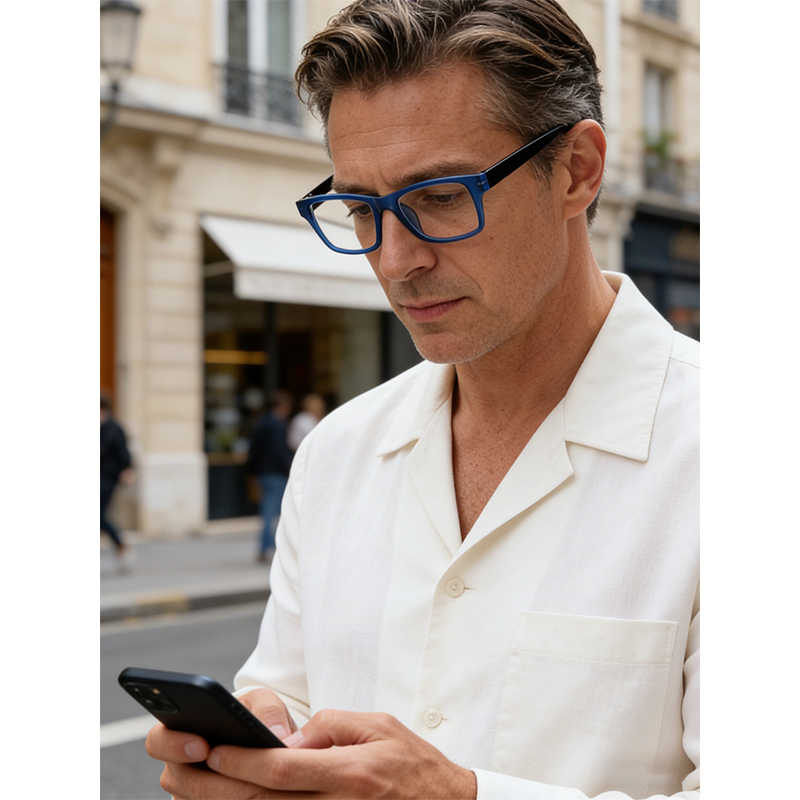
I. The Demographics of People Who Need Reading Glasses: From Blurred Vision to Clear Vision
Presbyopia is not a disease, but a physiological phenomenon caused by the gradual hardening and weakening of the lens of the eye with age, leading to a decline in the ciliary muscle’s accommodative function. It typically begins around age 40-45 and is almost unavoidable for everyone. If you or your clients experience the following “signals,” it means you need reading glasses:
Blurred near vision: Having to move a phone or book further away to see clearly is the most typical early sign.
Eye strain and headaches: Eye strain, soreness, and headaches are common after close-up work (such as reading, crafts, and computer use), which can be relieved by rest.
Increased light requirements: Reading in dim light is particularly difficult, requiring brighter lighting to see small print clearly.
Slower accommodation: A longer “focusing” time is needed when suddenly switching from looking at distant objects to close ones.
Specifically, people in their early 40s may experience eye fatigue after prolonged use and need occasional assistance; people around 50 years old usually need to wear reading glasses all day for reading and work; people over 60 years old have more stable presbyopia, but may also have complex refractive problems such as myopia and astigmatism, requiring more precise optical correction.
II. Scenarios where reading glasses are needed: From the study to all areas In modern life, the application of reading glasses has expanded from the single “study reading” to all aspects of daily life:
Reading and learning: Reading paper books, newspapers, and magazines is the most classic use case.
Digital Device Use: Checking screens on mobile phones, tablets, and e-books is the most frequent need among middle-aged and elderly people today.
Fine Work: Activities requiring close-range fine vision, such as sewing, handicrafts, painting, and model making.
Daily Life: Reading medicine instructions, consulting recipes while cooking, and checking price tags while shopping at the supermarket.
Office Work: Reading documents, using computers, and taking meeting minutes; for middle-aged and elderly people still in the workplace, reading glasses are a guarantee of work efficiency.
Multi-Scene Switching: For users who need to see objects clearly at both near and far distances (such as lecturing, attending meetings, and stocking shelves at the supermarket), progressive multifocal reading glasses allow for seamless switching, avoiding the embarrassment of frequently taking them on and off.
III. The History of Reading Glasses: From Handheld Mirrors to Smart Accessories
The history of reading glasses is a history of human wisdom in combating vision decline.
Ancient Times to the Middle Ages: Primitive Magnifying Tools
The earliest reading glasses can be traced back to the 1st century AD, when the ancient Roman philosopher Seneca used a glass ball filled with water to magnify text for reading. In the 13th century, Italian monks invented a handheld reading stone, using crystal or glass ground into convex lenses to magnify text on book pages—the prototype of reading glasses.
Renaissance Period: The Birth of Pince-Nose Glasses
From the late 13th to the early 14th century, wearable eyeglasses appeared in Florence and Venice, Italy. Early glasses were double-lens lenses clipped onto the bridge of the nose, without temples, held in place by the bridge. These glasses were primarily used to correct presbyopia and were called “geriatric glasses.”
18th-19th Centuries: The Popularization of Temple Glasses
In the 18th century, temple glasses gradually became more common, solving the problem of wearing stability. At the same time, Benjamin Franklin invented bifocal lenses, combining lenses for distance and near vision, providing convenience for presbyopic users.
20th Century: A Revolution in Materials and the Birth of Progressive Multifocal Lenses
The 20th century was the golden age of eyeglasses technology. The invention of resin lenses greatly reduced the weight of eyeglasses; progressive multifocal lenses (invented by Essilor in France in 1959) enabled a seamless transition from far to near vision, freeing reading glasses from the stereotypical image of “old people’s glasses.” Frame materials have also evolved from metal and celluloid to acetate, TR90, and titanium, achieving a unity of aesthetics and function.
21st Century: Intelligent and Personalized Contemporary reading glasses are developing towards intelligence and personalization. Anti-blue light lenses have become standard in the digital age, photochromic technology enables seamless switching between indoor and outdoor environments, and 3D printing technology makes personalized customization possible. Reading glasses have evolved from a simple functional tool into a composite product integrating optical technology, ergonomics, and fashionable aesthetics.
IV. We—Your Professional Reading Glasses Customization Partner In this historically rich yet constantly evolving category, choosing the right partner is crucial.
Comprehensive Product Portfolio: We boast a vast library of reading glasses styles covering all ages, scenarios, and materials, from classic single vision to high-end progressive lenses, from acetate to titanium. Whether it’s small-batch spot purchasing for rapid market validation or large-scale custom design for your exclusive brand, we provide agile and reliable supply chain support.
In-depth Brand Customization Services: We are committed to helping you create a complete brand experience. From the intricate logo engraving on the temples to a complete brand packaging solution perfectly matching your product style (including eco-friendly eyeglass cases, carrying bags, and professional cleaning cloths), we ensure your brand philosophy is accurately conveyed at every touchpoint.
The story of reading glasses is about clarity, care, and quality of life. Choose us, and let us work together to combine optical intelligence with human-centered design, providing the perfect pair of reading glasses for every user worldwide who seeks clear vision.
Post time: Feb-28-2026